
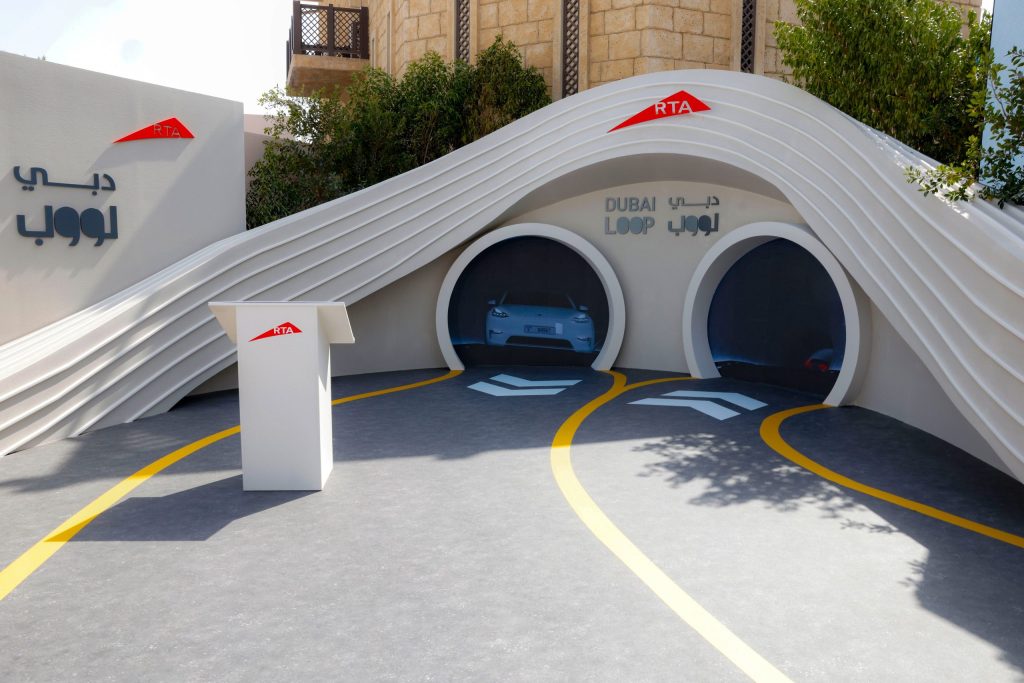
The Dubai Loop is a planned underground tunnel transport system being built by Elon Musk’s Boring Company under a February 2026 agreement with Dubai’s Roads and Transport Authority. Unlike Dubai Metro, which runs trains on rails, the Loop runs Tesla-style electric vehicles on dedicated single-lane tunnels at street-grade speeds underground. Passengers book a trip at a station and are driven directly to their destination without stops — like a private taxi, except the taxi is in a tunnel that bypasses surface traffic.
This is the second commercial Boring Company project. The first, the Vegas Loop, has been operating beneath the Las Vegas Convention Center since 2021 and uses Tesla Model 3, Model Y and Model X vehicles. Dubai’s network is significantly larger in plan: 22.2 km, 19 stations at full build, with capacity for tens of thousands of passenger trips per day.
Don’t confuse it with Hyperloop. The Dubai Loop is not the Hyperloop — that is the unrelated high-speed concept variously claimed for the Dubai–Abu Dhabi corridor over the past decade. Loop is a slower, simpler, in-city people-mover at car speeds. Hyperloop, in any of its corporate forms, is not currently in Dubai’s confirmed pipeline.
Timeline — confirmed vs speculative
| Date | Milestone |
|---|---|
| February 2026 | RTA and Boring Company sign agreement at the World Governments Summit |
| First half of 2026 | Design finalised; mobilisation begins |
| Second half of 2026 | Permitting (~48 permits across ~10 entities); start of tunnelling |
| Phase 1 budget | ~AED 565 million (USD 154 million) |
| Phase 1 delivery | ~1 year from tunnelling start |
| Projected first ride | Late 2027 at the earliest (PlaidCars estimate, see editorial section below) |
What is speculative or unconfirmed:
- A “mid-2026 operational” headline appears in some coverage but does not square with tunnelling that has not yet started. Tunnel-boring at this scale takes considerably longer than six months. Treat the operational date as late 2027 at the earliest for phase 1 with normal-execution risk. The Vegas Loop’s first phase took roughly two years from breaking ground to first ride, and that was a closed-campus pilot under one private owner.
- Fare structure has not been published. Per-station fare, per-trip flat, monthly subscription — all open.
- Vehicle mix has not been disclosed. The Vegas Loop uses Tesla Model 3, Y and X; Dubai’s mix is presumed similar but unconfirmed.
- Full-network completion has not been dated. Phase 1 is the only contracted scope.
PlaidCars’ read: announcements out of Dubai’s transport authority are typically delivered, but on extended timelines. Etihad Rail’s freight network slipped multiple years between announcement and operation; Dubai Metro added years to original plans. Treat Loop’s published dates as floor estimates, not ceilings.
How it would work for riders
Phase 1 connects four stations: ICD Brookfield Place and DIFC 2 in DIFC, then Zabeel Dubai Mall Parking and Burj Khalifa in Downtown. The full route is 6.4 km — the corridor that most Downtown-to-DIFC commuters spend 30 minutes a day driving on the surface.
A typical Loop trip works like this. You walk into a station, tap an entry mechanism (RTA stored-value card, Nol card, or operator app — none of the three specified yet for Dubai), and a vehicle pulls up within seconds at moderate headway. You name your destination station; the vehicle drives you directly there without stopping at intermediate stations. The tunnel sections between stations are single-lane, with vehicles passing in opposite directions via separate parallel tunnels.
Capacity numbers vary by source. The Boring Company has publicly cited 20,000 passengers per hour at full build across the 22-km network; other coverage cites 30,000 passengers per day. The two are not contradictory — one is theoretical peak throughput, the other is operating expectation. Either way, Loop is sized as a complement to Dubai Metro, not a replacement: Metro moves hundreds of thousands of passenger-trips per day. Loop is a first-mile / last-mile and a Downtown-to-DIFC shortcut, not a mass-transit spine.
Tunnel diameter is approximately 3.6 m (12 ft), built for Tesla-class vehicles rather than rail. Speed claims sit at car-speed grade — 60–100 km/h between stations rather than the higher figures suggested by early Boring Company marketing. The Vegas Loop’s actual operating speed, documented in independent reviews, has been lower than the marketed maximum; Dubai’s spec is presumed similar.
For Tesla owners: Loop is a passenger service in operator-owned cars. Your own Tesla cannot enter the tunnel network. The vehicles inside are operator fleet.
Why Dubai, not other cities
Three factors make Dubai the most plausible second Boring Company city.
Density of high-traffic short distances. Loop’s economics work where many people make short trips between a small number of valuable end-points. Downtown Dubai to DIFC, two of the city’s highest traffic-density corridors, is exactly that pattern. London and New York have the demand, but their soil, regulatory environment and existing tunnel density make tunnelling slow and expensive. Las Vegas worked because the Convention Center is a closed campus. Dubai is the first major-city test of the model on a public corridor.
Political appetite for visible projects. Dubai’s government runs on a 5- and 10-year planning horizon and is comfortable funding speculative infrastructure to attract attention and investment. Most municipalities cannot move that fast on novel projects. The RTA’s willingness to sign a partnership agreement, commit AED 565 million, and start permitting inside a year matters as much to project viability as the engineering does. For Dubai’s other forward-looking mobility bets, see our explainer on the Dubai Autonomous Zone.
Climate fits a tunnel. Outdoor walking distances of more than 200 metres are uncomfortable in Dubai for 6–8 months of the year. A tunnel-based people-mover delivers passengers underground, climate-controlled end to end. Cities with mild climates already solve this problem with bike lanes and surface trams — neither is realistic in Dubai’s summer.
Where it could underperform. The economics depend on per-trip revenue exceeding per-trip vehicle and tunnel operating cost. The Boring Company has not published Vegas Loop operating financials. The Dubai project will be measured in 2028–2029 on whether trip volumes hit the published targets and whether the per-trip fare is something residents and tourists actually pay.
What buyers and Tesla owners should know
Loop is a passenger service. It does not replace owning a Tesla — your car cannot enter the tunnel, and Loop’s coverage is intentionally narrow (Downtown corridor only at phase 1). For commute and personal-mobility planning over the next two to five years, Loop is irrelevant; for the same horizon, normal road traffic in central Dubai is what actually shapes your driving.
Two indirect effects on Tesla ownership are worth knowing.
Public perception. A high-profile Boring Company project in Dubai keeps the Tesla brand visible in UAE press coverage even when Tesla itself isn’t running a marketing campaign. Brand momentum tends to support resale values modestly, though the effect is hard to isolate from other variables.
Charging-network neglect risk. The Boring Company is not Tesla; the Loop deal does not commit Tesla to expand the Supercharger or service-centre footprint. UAE Supercharger build-out remains Tesla UAE’s separate decision. The PlaidCars Supercharger map of Dubai covers what is actually in service today.
If you are buying a Tesla to commute Dubai Marina to DIFC, plan around current road conditions. The Loop, if it lands on the published timeline, is a 2028+ operational tailwind, not a 2026 one.
PlaidCars’ take
The Dubai Loop is the right project for Dubai and a difficult execution. The case for it is sound — short, dense, high-traffic corridors that need a fast, climate-controlled alternative to surface transport, plus a city government with the appetite and budget to fund a novel system. The case against it is operational. Tunnelling 22 km is a substantial civil-engineering programme, the permit volume is large (~48 permits across ~10 entities), and the Vegas Loop’s operating data is thin enough that nobody outside the Boring Company knows exactly what Dubai is buying.
The most informative milestone in the next 18 months will be the start of phase-1 tunnelling. If construction begins on schedule in the second half of 2026, the timeline becomes more credible. If it slips by 6+ months, the first ride moves into 2029 or later. The Gulf News breakdown of phase-1 stations is the most concrete public reporting to date.
PlaidCars covers the UAE Tesla market — used and rental — and the Loop is adjacent to that market without being inside it. We will cover Loop when the news is concrete. The first Loop ride will be a moment worth marking. Until then, the Tesla buying guide is the more practical read for anyone making a Tesla decision in Dubai right now.